

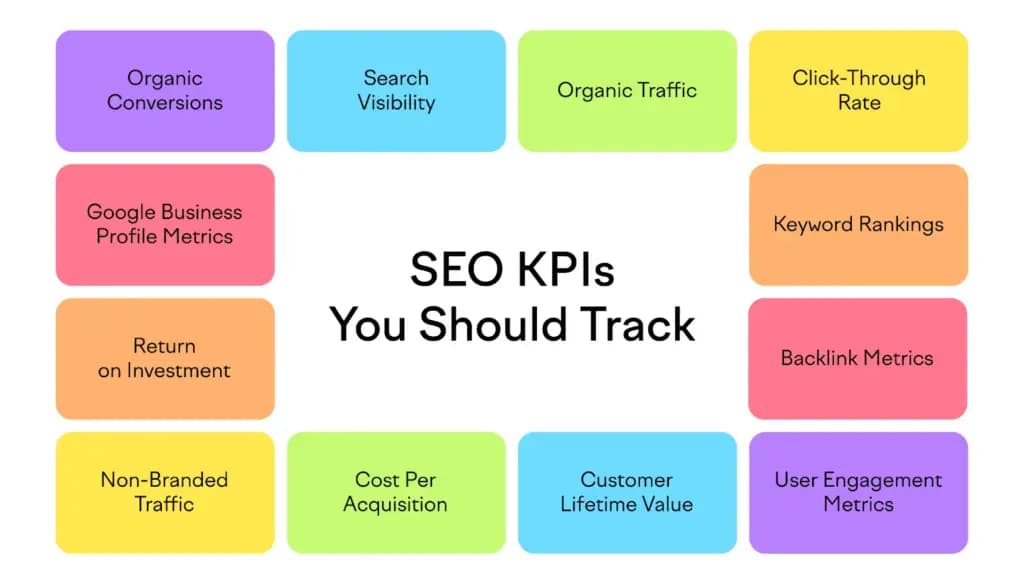
“Realistic SEO results” means different things depending on what kind of business you run. For a local plumber, it means calls. For an e-commerce store, it means product page traffic. For a SaaS company, it means trial signups from organic search. The timeline might be similar across all three – 3 to 6 months for meaningful movement – but what you should actually be measuring at month 3 versus month 6 varies considerably.
This guide gives you concrete benchmarks for each scenario. Not ranges so wide they’re useless. Actual numbers, by business type, that tell you whether you’re on track.
What “Results” Actually Means in SEO
Before the benchmarks, a quick definition problem worth addressing: most people conflate three distinct things when they say they want “SEO results.”
Rankings are where your pages appear in Google search results for specific queries. A page moving from position 28 to position 14 is a ranking improvement – even if it drives zero additional traffic, because position 14 is still on page 2.
Traffic is the actual number of visitors arriving via organic search. Traffic doesn’t increase meaningfully until you reach page 1 – specifically, the top 5 positions, where roughly 67% of all clicks go (Search Engine Land, 2024).
Leads or revenue is what most business owners actually care about. This is organic traffic that converts – calls, form submissions, purchases, trials. Organic conversion rate varies enormously by industry but typically runs 2–4% for service businesses and 1–3% for e-commerce.
All three matter, but they move at different speeds. Rankings move first. Traffic follows. Conversions follow traffic. If you’re at month 2 and not seeing more calls yet, that doesn’t mean SEO isn’t working – it may mean you’re between stages.
Realistic SEO KPIs for Local Service Businesses
Local service businesses – plumbers, electricians, dentists, salons, accountants – compete in geographically bounded markets. That’s a structural advantage. You’re not fighting national brands for every keyword.
The ranking landscape is also different. Local queries trigger Google’s map pack – the three business listings that appear above organic results. For a local business, appearing in the map pack is often more valuable than a position 1 organic ranking, because map pack results show ratings, reviews, and click-to-call directly in the results page.
Realistic benchmarks:
At month 3, a local service business doing consistent SEO work should expect:
- 2–5 new keywords appearing in the top 20 (positions 11–20, i.e., page 2)
- Impressions in Google Search Console up 20–40% from baseline
- At least one target keyword moving from page 3 or beyond into the page 2 range
- Map pack visibility improving for 1–2 local queries if Google Business Profile has been optimized
At month 6, the realistic picture for a local service business:
- 1–3 keywords on page 1 for local or niche queries
- Organic traffic up 30–60% from pre-SEO baseline
- 3–8 additional monthly enquiries attributable to organic search (depends on conversion rate and call tracking setup)
- Google Business Profile calls and directions clicks measurably increasing
These numbers assume moderate local competition. In a low-competition market – a specialist tradesperson in a mid-size town – results come faster. In a high-competition city market, they take longer.
Realistic SEO KPIs for E-Commerce
E-commerce SEO involves a larger surface area – potentially hundreds or thousands of product and category pages – and the benchmarks look different from local service businesses.
The challenge with e-commerce is that product pages are hard to rank quickly because they compete with established retailers that have significant domain authority. The faster wins usually come from category pages and informational content (buying guides, comparison articles) that funnel readers toward product pages.
Realistic benchmarks:
At month 3 for a small e-commerce store (under 500 products):
- Site audit issues resolved: duplicate title tags across products, missing meta descriptions, canonical issues
- 5–15 new keyword impressions in Search Console (mostly long-tail, low-volume terms)
- 1–2 category pages showing ranking movement (from position 30+ into the 15–25 range)
- Organic sessions up 10–25% – modest, because most movement is still on page 2 and below
At month 6:
- 3–7 category pages with positions in the top 20
- 1–2 informational articles reaching page 1 for long-tail queries
- Organic sessions up 40–80% – this is where meaningful traffic starts
- Revenue from organic search starting to appear in attribution reports (even if modest)
One thing e-commerce operators often miss: the long-tail opportunity. A product page for “navy blue linen blazer women UK size 14” won’t get 10,000 searches a month. But it might get 50 highly specific searches from people who are ready to buy. Ranking for 200 of those product-specific terms matters more than chasing one broad keyword.
Realistic SEO KPIs for SaaS and Online Services
SaaS and online service companies (agencies, consultants, platforms) compete in markets that are often national or global, with well-funded competitors who have invested in content for years. The realistic timeline is longer, and the initial wins tend to come from informational content rather than direct product rankings.
The SEO strategy for SaaS is also more content-intensive. You’re trying to rank for the questions your target customer asks before they know they need your product. That requires building a content library, not just optimizing existing pages.
Realistic benchmarks:
At month 3 for an early-stage SaaS or service business:
- Technical foundation clean: Core Web Vitals passing, no major crawl errors, structured data implemented
- 3–8 informational articles published and indexed
- Early ranking signals: articles appearing in Search Console for relevant queries, even at position 40–60
- Domain authority signals beginning to build (if content earns mentions or backlinks from adjacent sites)
At month 6:
- 2–5 informational articles reaching page 1 for specific long-tail queries
- Branded search volume beginning to appear (a signal that content is generating awareness)
- Trial signups or demo requests from organic starting to appear in attribution
- 100–300 monthly organic visitors for a new SaaS (this sounds small, but for a targeted B2B product, 200 qualified visitors is worth more than 2,000 untargeted ones)
The honest reality for SaaS: month 6 results are often still modest by traffic standards. The ROI case becomes clearer at month 9–12, when the content library has accumulated enough authority to compound. Early-stage SaaS teams that abandon SEO at month 4 because it “isn’t working” consistently underestimate how close they were to the inflection point.
The KPI Summary Table
| Business Type | Month 3 Benchmarks | Month 6 Benchmarks |
|---|---|---|
| Local service | 2–5 new page-2 keywords; impressions +20–40%; map pack visibility improving | 1–3 page-1 keywords; organic traffic +30–60%; 3–8 additional monthly leads |
| E-commerce | Site audit fixed; 5–15 new keyword impressions; organic sessions +10–25% | 3–7 category pages in top 20; sessions +40–80%; organic revenue starting to appear |
| SaaS / online services | Technical foundation clean; 3–8 articles indexed; early ranking signals at position 40–60 | 2–5 articles on page 1 for long-tail; 100–300 monthly organic visitors; branded search emerging |
Signs SEO Is Working Even When You’re Not on Page 1 Yet
This section is worth reading carefully. A lot of business owners look at their rankings in month 2, see nothing on page 1, and conclude that nothing is happening. That conclusion is usually wrong.
Here’s what progress actually looks like before page-1 rankings materialize:
Impressions are climbing in Search Console. Google is showing your pages for more queries, even at positions 20–50. That’s signal accumulation – Google is testing how users respond to your content in less competitive ranking positions.
Your rankings are moving in the right direction. A keyword going from position 45 to position 22 in six weeks is real progress, even though you’re still on page 3. The velocity matters.
Crawl frequency is increasing. Check your Search Console coverage report over time. If Google is crawling your site more frequently, that’s a positive technical signal – it means your site is seen as actively updated and worth reindexing.
New keywords are appearing in your Search Console data. You started with impressions for 40 queries. Now you have 180. That’s organic footprint expansion – your content is getting evaluated for more and more searches, even if it hasn’t broken through to high positions yet.
Your domain authority (or domain rating) is growing. If you’re earning backlinks – even a few per month from relevant sites – your domain authority score will increase. This makes it easier for all of your pages to rank, not just the ones you’re actively targeting.
None of these replace page-1 rankings. But they’re real indicators that the foundation is building correctly.
How to Track This Without Losing Your Mind
Checking rankings daily is a common mistake. Google rankings fluctuate by several positions every day as part of normal reindexing. A two-position drop on a Tuesday morning is not a trend – it’s noise.
A sustainable tracking rhythm for realistic SEO result monitoring:
Look at your weekly ranking changes for keywords that matter. Not every query in your Search Console – your priority keywords. Are they moving in the right direction over rolling 7-day windows?
Review monthly traffic trends in Google Analytics. Compare month-over-month and year-over-year to account for seasonality. A 15% traffic increase in February compared to January might mean nothing if February is always your slow month. Compare February this year to February last year.
Check your Search Console impressions and CTR monthly. Rising impressions with flat CTR often means you’re ranking for more queries but still in low positions. Rising CTR means you’re moving into positions where users actually see and click your result.
OvoSEO’s Rank Tracker logs daily position changes across your priority keywords and surfaces them as weekly trends rather than raw daily data – so you see movement without the noise. The Dashboard’s “Wins This Week” section highlights keywords that moved meaningfully upward, new page-1 entries, and traffic changes, all in one view. When you need a structured summary – for yourself, a business partner, or a stakeholder – the Reports feature generates downloadable metrics without requiring you to build a presentation from scratch.
Common Questions About Realistic SEO Results
My competitor jumped from page 3 to page 1 in a month – why is mine taking longer?
Domain age and existing authority are the most common explanations. An established site with years of indexing history and accumulated backlinks processes ranking improvements faster than a newer domain. Your competitor may also have had fewer technical issues holding them back, or they were in a less competitive keyword cluster. Neither means your results won’t come – it means the starting conditions were different.
What’s a realistic organic traffic increase in 6 months for a small business?
For most small business sites starting from a low baseline (under 500 monthly organic visitors), a 50–100% increase in 6 months is achievable with consistent work. That might mean going from 200 to 350 monthly visitors – not dramatic in absolute terms, but meaningful if your conversion rate is strong.
Should I be worried if my impressions go up but clicks don’t?
Not immediately. Impressions rising ahead of clicks is normal and expected. It means Google is testing your pages for more queries, mostly in positions where users don’t click (below position 10). As your pages move into positions 1–10, the click-through rate will increase significantly – position 3 gets roughly 15x more clicks than position 15.
How do I know if my SEO effort is actually causing the traffic increase?
Check your traffic source breakdown in Google Analytics. Organic search traffic is tracked separately from direct, social, and referral traffic. If organic is growing while other sources stay flat, the increase is attributable to SEO. For more precision, compare which specific landing pages are gaining organic traffic and cross-reference those with the pages you’ve been optimizing.
The Bottom Line
Realistic SEO results depend on your business type, your starting point, and your competitive landscape. But the pattern is consistent: ranking signals accumulate in months 1–3, traffic follows in months 3–5, and leads or revenue become measurable by month 6.
The businesses that get frustrated and quit at month 3 are almost always the ones who were looking at the wrong metrics. Impressions, keyword position velocity, and crawl frequency aren’t vanity metrics – they’re leading indicators that tell you whether the lagging indicators (traffic, leads) are coming.
They usually are.
Track Your SEO Progress – Free with OvoSEO
OvoSEO shows you what moved each week: keywords climbed, new traffic, pages improved. You stop guessing and start knowing.